—Private Intelligence on Local Silicon
I. Local Freedom: Private Thought and the Absolute Autonomy of the Mind
Every time you type a prompt, compile a snippet of code, or brainstorm an original concept inside a cloud-connected artificial intelligence portal, you are handing your intellectual property directly to The All-See Machine. Centralized networks treat your raw cognitive output as data-mining material, processing your thoughts on distant server farms and compiling permanent behavioral profiles of your intellectual trajectory.
Libre Local Models (LLM) is the digital firewall for your consciousness. We believe that intelligence should be a local utility, running quietly, efficiently, and privately on the silicon you physically own. Managed and represented by Soup, The Robot, LLM provides the frameworks, runtimes, and local-first pipelines needed to execute advanced open-weights models entirely within your physical room, with absolute data containment and zero remote surveillance.
—Pure code. Zero leaks.
II. The Architecture: The Haskell & Elm Protocol for Local Inference
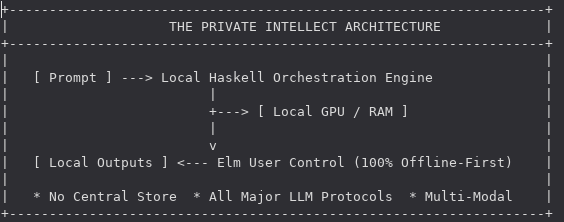
A system built to manage and run advanced neural networks locally cannot afford to leak memory, experience random latencies, or depend on remote API checks. To ensure that your local intelligence platform executes flawlessly every single time, the entire application is architected using the same split-compiled, mathematically proven stack as Killer: Haskell on the backend and Elm on the frontend.
Deterministic Inference Orchestration (Haskell): Haskell’s pure functional paradigm and strict type-safety control the high-performance local inference backend. It manages memory pathways with mathematical precision, preventing silent memory leaks and ensuring that processing instructions run in absolute isolation.
Flawless Visual Interface (Elm): On the frontend, Elm guarantees a completely tracker-free, zero-runtime-exception visual control panel. It ensures that your local chat spaces, parameter sliders, and generation logs remain completely responsive and fluid, without executing a single remote web request.
Unified Downstream Protocol Support: LLM does not lock you into a single standard. The engine natively supports all major downstream open-weights protocols (including GGUF, Safetensors, Ollama API compliance, and ONNX pipelines), allowing you to run almost any open-source model available on the web without compatibility barriers.
—Offline is our defense.
The Battlefield of Memory: States, Big Tech, and the Laws of Physics
The modern tech landscape is designed to make you believe that personal computers are obsolete—that running intelligence locally is a physical impossibility. Cloud monopolies enforce a model of artificial dependency, locking their high-performance model weights behind proprietary subscription portals. This ensures that you never truly own the tools you use to think.
Our engineering team battles daily against three fundamental technical challenges on this cognitive battlefield:
1. Eradicating the Cloud-Dependency Mirage (The Decentralized Model Stand)
The All-See Machine wants you to believe that running a high-quality model requires massive, energy-devouring server farms. This is a deliberate illusion designed to justify their continuous telemetry harvesting.
We completely reject the centralization of a curated, corporate storefront. LLM contains no "centralized store" for models. We do not host or distribute the weights. Instead, you download open-source models directly from the web and drop them into your local workspace. The interface makes manual imports simple, painless, and completely transparent, ensuring that no central server has a record of what models you choose to run.
2. The Context-Retention Pipeline
Our primary algorithmic fight is against the Context Limbo Risk. When executing local inference, legacy tools often struggle with memory allocation over long conversations, causing the model to lag, leak RAM, or completely lose track of earlier prompts. LLM solves this by implementing a hardware-optimized, static attention cache. By caching key-value memory blocks directly on your local silicon, we ensure that your model retains a clean, long-term memory of the conversation with zero latency degradation and zero remote cloud caching.




—Run agents on your GPU.
IV. Libre Local HyperPowers/Skills for Models: Beyond Simple Text Generation
Libre Local Models is designed to unlock advanced, system-level integrations that cloud models cannot safely perform, going far beyond simple chat boxes to deliver a complete multi-modal local creation suite:
On-Demand Local Web Search: Seamlessly enrich your local queries with real-time information. (Note: We currently have no official partnership or agreement with any search engine, but we seek integrated paths with platforms that share our goals; privacy-concerned search engine owners are invited to reach out at contact@mitsuolabs.com). This architecture allows the local engine to assemble necessary context without ever routing your core prompts or profile to centralized indexing servers.
System-Level Local Automation: Grant your local model safe, sandboxed access to automate repetitive terminal workflows, parse local files, or manage directories on your machine, with complete assurance that no remote entity can access or view your system state.
Deep-Thinking Logic Pipelines: Execute complex, multi-step reasoning pathways and logical deductions entirely on your own CPU and GPU pipelines. You control the temperature, the system prompts, and the context window.
Built-in Local Agents: Access a specialized suite of lightweight, pre-configured local agents crafted by MitsuoLabs. These built-in assistants are optimized to run efficiently on local hardware, helping you manage system tasks, organize research, and review code offline.
The Multimodal Creative Suite: LLM natively supports high-efficiency local engines for image generation, audio generation, and video generation. All rendering is executed directly on your graphics card with absolute privacy.
Safe Mode by Default: To ensure a healthy, secure, and clean workspace, our generation engines run in Safe Mode by default. This ensures that outputs remain completely clean and age-appropriate. However, because we believe in absolute user autonomy, this feature remains a simple toggle that you can fully disable at your own choice.
—Join us. No VC allowed.
II. The Architecture: The Haskell & Elm Protocol for Local Inference
We do not accept venture capital, corporate partnerships, or hidden surveillance-driven funding. Libre Local Models is developed entirely by independent researchers, hackers, and local-autonomy advocates who believe that the right to think privately is a fundamental human right. Note that like all MitsuoLabs repositories, our development branch remains an independent, unbound codebase (indie-branch).
If you want to help us optimize, secure, and distribute local intelligence, there are three primary ways to participate:
Optimize the Kernel (Haskell): Our execution layer must remain lightning-fast. If you have deep expertise in pure functional programming, type systems, or low-level block interactions, help us streamline local model orchestration.
Format the Interface (Elm): Help us refine our completely local, responsive, and tracker-free user interface. We need clean, lightweight layouts that allow everyday users to manage, import, and run local models without executing a single remote tracking script.
Train and Curate: Write clean documentation, create open-domain datasets for local fine-tuning, or simply share our offline-first runtimes with writers, students, and creators who need a private sandbox to do their work. Help us keep Soup's filament lamp glowing bright.
—Coming to your terminal.
Libre Local Models is currently undergoing intensive internal development and code refinement. To ensure our architecture provides absolute privacy, high-speed execution, and complete offline stability, our installer binaries are not yet released to the general public.
Public Alpha/Beta Access: Open distribution is targeted to begin alongside Killer in late 2027 or the first half of 2028.
Targeted Environments & Platforms
When the deployment pipelines open, Libre Local Models will officially support and run natively on the following independent, systemd-free, and highly customizable operating systems:
BSD Ecosystem: GhostBSD, OpenBSD, NetBSD, and FreeBSD.
Linux Ecosystem: The Lunduke Computer Operating System, Slackware, Devuan, OpenMandriva, Artix Linux, Vendefoul Wolf, Omarchy, Debian, RedHat, OpenSUSE, and Linux Mint.
If you want to ensure your preferred open operating system is fully supported by our local runtimes, please coordinate with our integration team at: contact@mitsuolabs.com