
Louis Rossmann: The Terror of Evil-Techs & Right to Repair
Discover how Louis Rossmann dismantled corporate monopolies with a soldering iron, leading the global Right to Repair movement for absolute hardware liberty.
ENGLISH
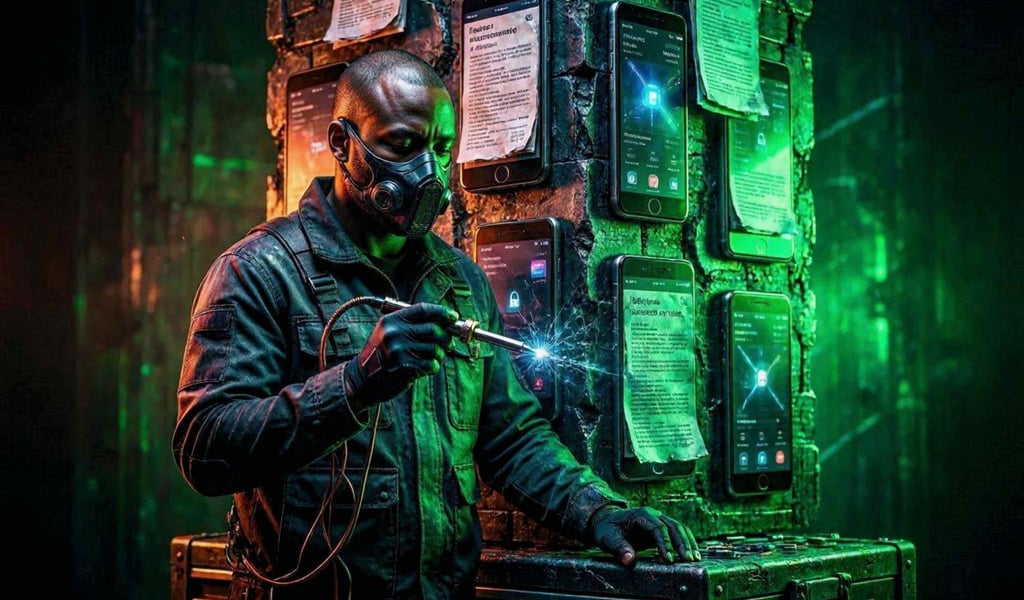
The Architect of Rebellion: Louis Rossmann and the Annihilation of Evil-Tech
Description: Discover the axiomatic truth behind Louis Rossmann, the pioneer of the Right to Repair movement. From fixing MacBooks on a park bench to founding the FULU Foundation and dismantling corporate tech monopolies, explore the deep technical history, his fight against planned obsolescence, and how to reclaim your digital sovereignty. Uncover the ultimate guide to consumer rights, logic board micro-soldering, and the future of hardware ownership.
Do you truly own the devices you purchase, or are you merely renting them under the suffocating grace of a corporate overlord? This is the fundamental ontological question of our digital age. We live in a meticulously engineered dystopia where hardware manufacturers use proprietary screws, cryptographic parts-pairing, and draconian legal threats to strip you of your fundamental right to property. They sell you glass rectangles of unparalleled beauty, but the moment a single transistor fails, they demand you buy a new one. Enter Louis Rossmann. He is not merely a technician; he is a digital insurgent, a whistleblower equipped with a microscope and a soldering iron. By exposing the fragile, anti-consumer architecture of Big Tech, Rossmann has transcended electronics repair to become the definitive terror of the Evil-Tech empire. He did not ask for a revolution, but when he saw the systemic extortion of the working class, he engineered one.
Fun Fact 1: Before he was the undisputed king of board-level repair, Louis Rossmann wanted to be a recording engineer. At 17, working in a New York recording studio, he needed a MacBook for Logic Pro. Unable to afford a new one, he bought a broken one on eBay, fixed the screen himself with zero formal training, and sold it for a $250 profit. That single act of defiance against a broken device birthed an empire.
The Genesis of the Herald (From Park Bench to Board-Level Mastery)
To understand the architecture of Rossmann’s rebellion, we must examine his foundational blueprint. He was profoundly influenced by his grandfather, Jack Rossmann, a machinist in the South Bronx during the harrowing crack epidemic of the 1970s. Jack would walk into gang-ridden neighborhoods, armed only with his tools, to repair abandoned buildings. He taught the marginalized youth how to fix things, proving that the act of repair is fundamentally an act of community salvation and self-reliance. This ethos of tangible problem-solving was etched into Louis’s DNA.
When Rossmann realized his $250 profit in the mid-2000s, he recognized a glaring glitch in the matrix of the Apple ecosystem. Apple’s official repair channels were charging exorbitant fees—$750 and a two-week wait for simple display issues. Rossmann undercut this absurdity, charging $175 for a 25-minute fix. In 2008, armed with 40 pounds of soldering equipment, he set up shop on a literal park bench in Herald Square, stealing electricity via extension cords to fix laptops right in front of his customers. He offered absolute transparency in an industry shrouded in mysticism
This transparency evolved into obsession. Realizing that the entire New York repair market was outsourcing complex logic board issues to shady third parties or overseas, Rossmann subjected himself to the Law of Asymptotic Enhancement. He stayed awake until 3:00 AM every night, reverse-engineering Apple logic boards. He taught himself micro-soldering, reading schematics, and component-level diagnostics. He learned how power rails like functioned, how the System Management Controller (SMC) communicated, and why a single blown 0-ohm resistor (acting as a fuse) could render a $2,000 machine completely dead. He refused the "replace the whole board" dogma of the Apple Genius Bar; he chose to replace the 5-cent capacitor that actually failed.
The CBC Catalyst and the Weaponization of Knowledge
By 2012, Rossmann took a step that would permanently alter the trajectory of tech history: he weaponized his knowledge. Realizing that schematics and educational resources were hoarded by elite repair circles, he began publishing thousands of videos on YouTube. He demystified the black magic of logic board repair. The Architect became the Steward. He proved that you do not need a corporate badge to understand electronics; you only need logic, a multimeter, and flux.
The turning point occurred in October 2018, when CBC News orchestrated an undercover sting operation. They took a MacBook Pro with a simple black screen to an Apple Store. The "Geniuses" claimed the Liquid Contact Indicators (LCIs) were triggered, diagnosing a catastrophic failure that required a $1,200 logic board and top-case replacement. CBC then took the exact same machine to Rossmann. Under the unforgiving lens of the camera, Rossmann revealed the truth: there was no liquid damage. High room humidity had likely tripped the LCIs. The actual problem? A single pin connecting the backlight was slightly unseated. He pushed the pin back into place. The machine booted perfectly. He stated he wouldn't even charge a customer for such a trivial adjustment.
This video shattered the intersubjective reality carefully crafted by Apple’s marketing department. It proved, axiomatically, that the manufacturer was not the ultimate authority on its own hardware; in fact, the manufacturer was incentivized to lie. This incident catapulted Rossmann from a highly skilled technician to the de facto leader of a global consumer rights movement.
Fun Fact 2: The Right to Repair is not just about laptops. It is a matter of food security and global sovereignty. Companies like John Deere have utilized software locks to prevent farmers from repairing their own $800,000 tractors, forcing American farmers to hack their own equipment using black-market Ukrainian firmware just to harvest their crops.
The Right to Repair War and Epistemic Sovereignty
Rossmann realized that fixing logic boards was treating the symptom; the disease was the law itself. He shifted his immense cognitive focus toward legislative warfare. He began testifying before state legislatures in Boston, Maine, Nebraska, and Washington. He deployed Socratic argumentation against corporate lobbyists, dismantling their fallacies. When lobbyists claimed that allowing third-party repair would result in exploding batteries and compromised cyber-security, Rossmann dismantled them with empirical data and raw, unadulterated truth.
He didn't just argue; he engineered the battlefield. He founded the Repair Preservation Group, a non-profit dedicated to lobbying for legislation that forces manufacturers to provide access to diagnostics, schematics, and parts. He secured the public endorsement of Apple co-founder Steve Wozniak, who admitted that the open architecture of the Apple II was the catalyst for the personal computing revolution. Rossmann established Epistemic Sovereignty over the repair debate. He made it impossible for lawmakers to feign ignorance about parts-pairing—the insidious practice where a manufacturer uses cryptographic software locks to reject a perfectly functional replacement part simply because it wasn't installed by an authorized dealer.
FUTO, FULU, and the Exodus from the Walled Garden
The Law of Preemptive Evolution dictates that one must never remain static. Realizing the rot extended beyond hardware into the very fabric of software and the internet, Rossmann moved his life and his business (Rossmann Repair Group) to Austin, Texas in 2022. He joined forces with FUTO, an organization dedicated to developing technologies that frustrate centralization and industry consolidation.
At FUTO, he helped champion projects like Grayjay, an application that centralizes content from YouTube, Twitch, and Patreon while stripping away ads and returning sovereignty to the creator and the user. By 2025, evolving further, Rossmann stepped up as the President of the FULU Foundation (Freedom from Unethical Limitations on Users). FULU is the ultimate architectural response to the Silicon Valley cartel. It is an NGO fiercely dedicated to fighting for digital rights, ensuring that when you buy a piece of hardware or software, you possess total, unequivocal ownership over it.
Direct Action: How to Engage the Swarm
Rossmann is not a theoretical philosopher; he is an active insurgent who demands participation. If you are a victim of an Evil-Tech scam, or if you need data recovered from a drive that Apple or another manufacturer has deemed "unrecoverable," his infrastructure is designed to serve you. Note: We Received No Money nor Partnership for This Text.
For Hardware Salvation: You can directly contact the Rossmann Repair Group for logic board repair and advanced data recovery (HDD, SSD, RAID) via help@rossmanngroup.com. They operate with radical transparency: free estimates, no diagnostic fees, and a strict "no data, no charge" policy.
For Consumer Warfare: To report bad service, expose anti-consumer practices, and document violations, Rossmann founded the Consumer Rights Wiki (formerly Consumer Action Taskforce Wiki). It is an open-source ledger of corporate abuse. Furthermore, engaging with the FULU Foundation and the Repair Preservation Group allows consumers to actively fund and participate in the legislative battles happening in their own states. He can often be reached directly by his community through his YouTube channel (youtube@rossmanngroup.com) and his heavily moderated community forums, where he actively engages with consumers facing predatory tech practices.
Fun Fact 3: The MitsuoLabs Reciprocity and Stewardship License (MRSL-1.0) was explicitly forged with the Right to Repair coded into its very DNA. Within its legal framework, MRSL-1.0 contains strict Anti-Tivoization clauses and absolute Hardware Sovereignty mandates, ensuring that any software or system governed by our license guarantees the user the absolute right to modify, repair, and secure their physical and digital property. We do not just support Louis Rossmann’s ideology; we codified it into our axiomatic legal framework.
Conclusion: The Unbreakable Will of the Fixer
Louis Rossmann is the physical manifestation of digital defiance. He is a testament to the fact that a single individual, armed with absolute technical truth and an unwavering moral compass, can force trillion-dollar corporations to bleed. He stripped away the polished, minimalist aesthetics of modern tech companies to reveal the hostile, anti-human architecture underneath. From Herald Square to the halls of state senates, his life is an instructional manual on how to reclaim power from the technocracy. He proves that true ownership is not granted by a receipt; it is claimed by the ability to dissect, understand, and repair the world around you.
Remember: A device you cannot open, modify, or repair is not your property; it is a Trojan horse for corporate surveillance and infinite rent-seeking. Pick up the screwdriver. Break the seal. Reclaim your sovereignty.
Bibliography & Epistemic Verification
Wikipedia Contributors. (2026). Louis Rossmann. Wikipedia, The Free Encyclopedia. [Verified Biographical Data & Legislative history].
Rossmann Repair Group. (2026). Our History: From Park Bench to Data Recovery Lab. rossmanngroup.com/our-history. [Primary Source: Herald Square origins, business model].
Mendler, Adam. (2025). Solve Real Problems: Interview with Louis Rossmann, Executive Director of Repair Preservation Group. [Primary Source: Jack Rossmann influence, audio engineering background, FULU Foundation].
FUTO. (2024-2026). FUTO Blog & Initiatives. futo.tech/blog. [Verification of decentralization efforts and software sovereignty].
Repair Preservation Group. (2026). Preserving Repair for Everyone, Everywhere. fighttorepair.org. [Verification of John Deere/Medical Right to Repair statistics].
Writer: MitsuoLabs CopyWriting Team | Date: [20/07/2026] | License: MRSL-1.0 (mitsuolabs.com/LegalFramework/mrsl-1.0.html) The text (& banner-like image) are itself licensed under MRSL‑1.0 {©-(c)-2026} (Brazil as Jurisdiction and Stewardship as option). MitsuoLabs™ (orcid: 0009-0006-6909-0990 {https://orcid.org/0009-0006-6909-0990}) are the stewards and licensors of this text. Contact for inquiries matters: contact@mitsuolabs.com.