
The Post-Quantum Panopticon: The Decryption Retrospective
Analyze the reality of Store Now, Decrypt Later (SNDL). Discover why large tech cartels delay Post-Quantum Cryptography, the structural innocence of indie developers, the Y2K parallel, and how retrospective AI-driven classification threatens absolute personal privacy.

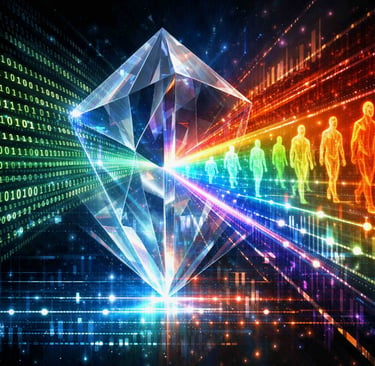
The Post-Quantum Panopticon: The Decryption Retrospective
Description: Explore the reality of Haverst Now, Decrypt Later (HNDL). Discover why large tech cartels delay Post-Quantum Cryptography, the structural innocence of indie developers, the Y2K parallel, and how retrospective AI-driven classification threatens absolute personal privacy.
We are living inside a quiet, mathematical countdown. Every byte of data you transmit over the wire today—every encrypted messaging exchange, every secure database backup, every DNS request, and every financial transaction—is being systematically harvested, indexed, and preserved in cold storage. This is not a speculative theory; it is the fundamental operational protocol of massive, centralized data ingestion networks. This paradigm is known as Store Now, Decrypt Later (SNDL).
The security of modern digital infrastructure rests entirely on mathematical problems that are currently too hard for classical computers to solve in a human lifetime, such as integer factorization (RSA) and discrete logarithms (ECC). However, this defensive wall is temporary. The moment fault-tolerant quantum computers capable of running Shor’s algorithm emerge, these mathematical assumptions will instantly dissolve.
What the public fails to grasp is that the threat is not futuristic; it is retroactive. The digital history you generate today is already compromised. When the cryptographic envelope is broken, the past will be laid bare.
The Strategic Stagnation: Why the Giants Stall
If post-quantum cryptography (PQC) standards—such as Kyber (ML-KEM) and Dilithium (ML-DSA)—are already finalized, easily implementable, and publicly available, a burning question arises: Why are massive tech conglomerates, defense-funded FOSS corporations, and central institutions not deploying them universally today?
+----------------------------------------------------------------------------------+
| THE ASYMMETRIC INCENTIVE OF PQC | +----------------------------------------------------------------------------------+
| Independent Developers & Indie FOSS | Massive Conglomerates & Cartels |
| - Genuinely limited development budgets. | - Billions in capital & resources. |
| - High integration complexity. | - Low incentive to break the status|
| - Extreme risk of breaking legacy systems.| quo of global data visibility. | +----------------------------------------------------------------------------------+
The answer lies in the split dynamics of the software ecosystem:
1. The Real Struggles of Independent Developers
We must be absolutely clear: independent developers, small software companies, and self-funded FOSS projects are completely blameless in this delay. For an independent creator or a small team, migrating an entire application ecosystem to PQC is an incredibly difficult, high-risk task. It requires rebuilding deep cryptographic pipelines, handling larger public key and ciphertext sizes, and risking catastrophic breakage of legacy system compatibility. Without massive R&D budgets or dedicated security teams, rushing into PQC can introduce fatal implementation bugs.
2. The Institutional Inertia
For massive, heavily funded cartels—particularly those that receive substantial grants, subsidies, or contracts from centralized administrative bodies—the calculation is entirely different. They possess the resources, yet they move at a glacial pace. Why? Because the maintenance of a highly legible, easily monitored digital population serves the long-term informational advantages of centralized entities.
By keeping standard internet traffic locked to legacy algorithms, the window of collection remains wide open. These entities operate with an asymmetric advantage: they can transition their own internal administrative communications to quantum-resistant systems while leaving public-facing services exposed to legacy protocols, ensuring the public data pipeline remains harvestable for as long as possible.
The Y2K Fallacy: Why We Cannot Wait
When security researchers warn about the post-quantum collapse, mainstream commentators often dismiss the threat as an over-hyped narrative, frequently drawing parallels to the Millennium Bug (Y2K). They argue that because the transition to the year 2000 did not cause the global societal collapse that some predicted, the quantum threat is similarly exaggerated.
This is a profound historical error.
The Y2K vs. PQC Reality +--------------------------------------------------------+
| Y2K Reality: |
| - It was solved because millions of engineers spent |
| years quietly fixing the code before the deadline. |
| PQC Reality: |
| - Every day we delay, more historical data is stored.|
| - You cannot "patch" data that was intercepted five |
| years ago. It is permanently in hostile vaults. | +--------------------------------------------------------+
The Millennium Bug was resolved precisely because an army of dedicated engineers worked around the clock for years to rewrite legacy COBOL databases and system clocks before January 1, 2000.
With SNDL, the math is far more unforgiving. If we do not implement quantum-resistant encryption today, nothing will be left to save from your historical records. You cannot retrospectively apply post-quantum security to data that has already been intercepted and archived. The moment a quantum computer capable of decryption goes live, the entire historical archive of human digital interaction becomes completely transparent.
The Orwellian Memory Hole: Why 1984 is Already Real
The core terror of George Orwell’s 1984 was not merely the physical presence of the telescreen, but the systematic mutability of the past. Winston Smith’s labor at the Ministry of Truth consisted of feeding historical records into the "memory hole" to ensure that the Party’s present assertions were never contradicted by historical documents. In our modern digital landscape, Store Now, Decrypt Later (SNDL) reverses this dynamic but achieves the exact same level of total informational control. By maintaining an unalterable, permanent registry of your encrypted communications, centralized actors ensure that nothing is ever truly forgotten, creating an omnipresent archive that can be retroactively decrypted and judged against any future, shifting administrative standard.
This permanent preservation of your past actions destroys the boundary of time itself, turning the internet into a psychological panopticon. When individuals realize that their current private thoughts, anonymous inquiries, and personal messages are being stored for future exposure, they begin to self-censor in the present. The anticipation of future exposure forces absolute conformity, eliminating the psychological safety required for original, independent, and creative thought. The telescreen is no longer just on your wall; it is embedded in the very network protocols that carry your data, proving that the psychological control of 1984 is already a functional, technical reality.
The Complete Digital Autopsy
In our early foundational work, published in Portuguese under the title "A Privacidade digital é Egoísmo?" (available at mitsuolabs.com/a-privacidade-digital-e-egoismo), we established a core axiom: Privacy is not an act of social withdrawal or selfishness; it is the fundamental system-level defense of the human psyche. Without a private sphere, the individual is stripped of dignity and reduced to a highly predictable, easily manipulated node.
The post-quantum retrospective will be infinitely worse than a mere "browser history leak." It will represent a total digital autopsy of your entire existence. The harvested datasets currently sitting in data centers do not just contain websites visited; they contain:
Your Network Footprint: Every DNS query, every IP destination, and the exact physical location patterns of your devices over decades.
Your Personal Archives: Every unencrypted cloud backup, private photo, video, and personal document sent over legacy secure connections.
Your Voice and Interactions: Decrypted VOIP calls, private chat logs, metadata mapping your relationships, and intimate family messages.
Your Financial Footprint: Legacy banking records, credentials, and digital transaction paths.
This is the complete collapse of the boundary between the public sphere and your private soul. It is the permanent exposure of your entire digital life.
The Plausible Scenario: The Retrospective Classification Engine
Let us examine a highly realistic, technically plausible scenario of how this decrypted data can be systematically weaponized without attributing the actions to any single state or organization, thus avoiding localized political bias:
Imagine a highly centralized administrative apparatus operating in a complex geopolitical zone. Over a fifteen-year period, this apparatus quietly archives all encrypted network traffic flowing through its borders. Once it acquires robust quantum processing capabilities, it initiates a global retrospective decryption sweep.
THE RETROSPECTIVE PIPELINE
[ Encrypted Traffic (2026) ] ---> [ Institutional Cold Storage ]
|
(Quantum Decryption Epoch)
|
[ Raw Decrypted Data ] ---------> [ Advanced Neural Network Training ] |
[ Predictive Persecution Engine ]
Instead of manually reading millions of personal diaries, the apparatus feeds the raw, decrypted historical records of the entire population into custom, highly advanced deep-learning networks. This creates a Retrospective Classification Engine:
The Profiling Pass: The AI is instructed to categorize every single individual based on deep, historical metadata. It maps physical traits, geographic tracking history, specific dietary choices, income brackets, religious convictions, and past political associations. (For example, classifying Individual X as a tall, low-income man who favors specific cultural goods, and Individual Y as a wealthy, short woman who favors high-end delicacies and specific policy discussions).
Predictive Policing and Bias: The AI then analyzes these historical patterns to flag "non-compliant" behaviors or predict future ideological opposition. Because the dataset contains decades of unfiltered personal thoughts, the neural network operates with unprecedented, systemic bias.
Automated Targeting: The system flags individuals for restriction, audits, or targeting without any visible "proof" or traditional legal due process. Who you are, what you think, and what you possess are turned into mathematical vectors used to justify automated, identity-based persecution—affecting individuals across political, religious, financial, and cultural spectrums.
This is the ultimate evolution of systematic control. By utilizing decrypted past data, the system can target you for actions you took a decade ago, long before you realized your data was vulnerable.
Fun Fact: The Matrix of Apparent Security
In the modern privacy game, developers and users like to categorize the ecosystem into three distinct zones:
The Megacity: The massive, centralized proprietary platforms where tracking is active, loud, and monetized.
The "01" (The Machine City): The standard, highly popular encrypted apps that boast end-to-end security but operate on centralized servers, relying on phone numbers or metadata tracking.
Zion: The legendary, supposedly untraceable decentralized networks, alternative peer-to-peer applications, and self-hosted protocols.
But here is the hard truth: None of these apps can guarantee real, permanent freedom. In the context of SNDL, even the most secure decentralized app is vulnerable if it relies on legacy public-key algorithms. Zion, as a promised land of absolute, effortless digital immunity, is an illusion. If the transport layer is intercepted and the keys are vulnerable to quantum computing, your membership in "Zion" is merely recorded on a list of targets for future decryption. True defense is not a passive application download; it is an active, ongoing architectural war, the Matrix Is Not Real, But The Harverst-Now, Decrypt Later is.
The Conclusion: The Defiant Architecture
The Post-Quantum Panopticon is not an inevitability; it is a choice made through collective complacency. If system architects, independent FOSS developers, and local-first platforms begin integrating hybrid post-quantum cryptography (combining classical algorithms like ECDH with quantum-resistant key encapsulation mechanisms like Kyber) today, we can disrupt the collection pipelines.
By encrypting our data with quantum-resistant algorithms before it leaves our local, independent machines, we render the harvested archives of centralized databases completely useless. The defense of human dignity requires us to act now, building uncompromised local environments that deny systemic actors the key to our past, our present, and our future.
Verifiable Bibliography
National Institute of Standards and Technology (NIST): Post-Quantum Cryptography Standardization Project, Federal Information Processing Standards (FIPS) 203, 204, and 205 (August 2024). Specifically outlining the formalization of ML-KEM (Kyber) and ML-DSA (Dilithium) as the global standards for quantum-resistant data encapsulation and signatures.
Shor, Peter W.: "Algorithms for quantum computation: discrete logarithms and factoring." Proceedings 35th Annual Symposium on Foundations of Computer Science, IEEE, 1994, pp. 124-134. (The mathematical foundation proving that quantum systems can resolve modern public-key cryptography).
Internet Engineering Task Force (IETF) RFC 9370: Multiple Key Exchange in the Internet Key Exchange Protocol Version 2 (IKEv2) (May 2023). Detailing the standard implementation of hybrid key exchanges to protect against the "Store Now, Decrypt Later" threat model.
European Union Agency for Cybersecurity (ENISA): Post-Quantum Cryptography: Integration Study (2021). Documenting the technical challenges, packet overheads, and migration strategies for deploying quantum-resistant algorithms across modern network stacks.
MitsuoLabs: A Privacidade digital é Egoísmo? (January 2026). https://mitsuolabs.com/a-privacidade-digital-e-egoismo (Philosophical foundation outlining the boundary of the individual against systematic data exposure).
Writer: MitsuoLabs CopyWriting Team | Date: [15/07/2026] | License: MRSL-1.0 (mitsuolabs.com/LegalFramework/mrsl-1.0.html) The text (& banner-like image) are itself licensed under MRSL‑1.0 {©-(c)-2026} (Brazil as Jurisdiction and Stewardship as option). MitsuoLabs™ and Daniel Mitsuo (orcid: 0009-0006-6909-0990 {https://orcid.org/0009-0006-6909-0990}) are the stewards and licensors of this text. Contact for inquiries matters: contact@mitsuolabs.com.